
Hypertensive Crisis: How to Recognize and Provide First Aid to Save a Life
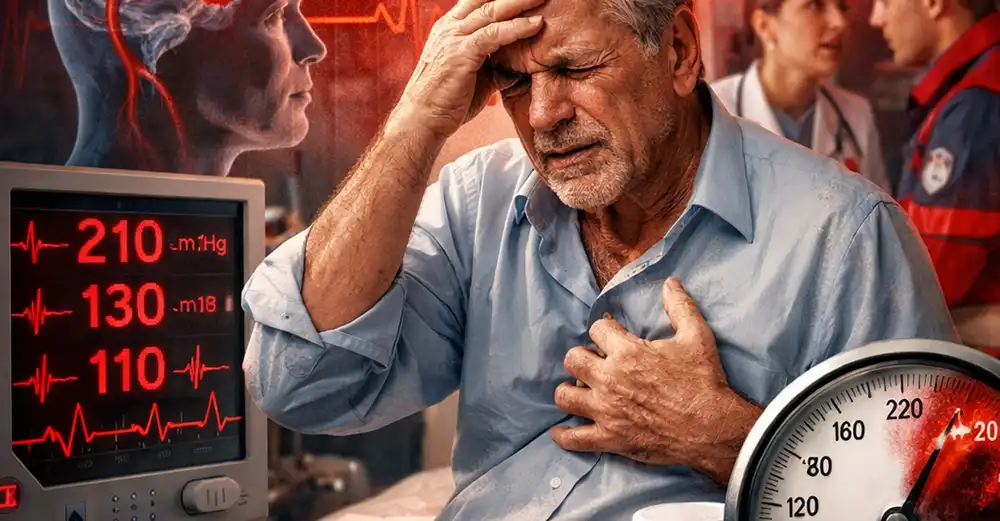
A hypertensive crisis is not just a "jump" in blood pressure. It is a critical condition in which a sharp increase in blood pressure threatens life due to the risk of damage to the heart, brain, and kidneys.
This condition is one of the most common reasons for calling emergency services. The main danger of a crisis lies in the patient's incorrect actions: attempts to "wait it out" or sharply lower blood pressure with inappropriate medications.
What is a hypertensive crisis "in simple words"?
This is a state when the numbers on the tonometer significantly exceed your individual norm, and the body does not have time to adapt to such a load.
Classic threshold: 180/110 mm Hg and above.
Important: If your usual pressure is 110/70, then even an increase to 150/90 may be accompanied by crisis symptoms.
Main symptoms: when the body sounds the alarm
Symptoms of a crisis appear suddenly:
- Head: Severe throbbing pain (most often in the back of the head), dizziness, ringing in the ears.
- Vision: Flashing "floaters", fog before the eyes.
- Heart: Sensation of rapid heartbeat, chest pain, shortness of breath.
- General condition: Nausea, vomiting, severe anxiety, facial flushing, hand tremors.
🚨 RED FLAGS (Call an ambulance immediately!):
- Speech impairment or "distorted" face.
- Sudden weakness or numbness in an arm or leg on one side.
- Severe squeezing chest pain that does not go away.
- Loss of consciousness or convulsions.
First aid algorithm: What to DO and what NOT to do
Before the arrival of medics, your task is to stabilize the condition, not to experiment with the medicine cabinet.
✅ YES, DO THIS
- Calm down and sit: Semi-sitting position (with a high pillow). This relieves the heart.
- Fresh air: Unbutton the collar, open the window.
- Control: Measure blood pressure every 15-20 minutes and record the readings.
- Take "first aid": Only those medications that the doctor prescribed in advance for emergency cases (e.g., Captopril or Nifedipine under the tongue).
❌ ABSOLUTELY DO NOT
- Sharply lower pressure: Lowering pressure by more than 25% in the first hour can lead to cerebral ischemia (stroke).
- Take other people's medications: Do not drink what "helped the neighbor."
- Lie down horizontally: This increases blood flow to the head and raises the risk of brain edema.
- Panic: Stress releases even more adrenaline, which increases pressure.
Why is self-treatment dangerous?
A hypertensive crisis is of two types:
- Uncomplicated: Target organs (heart, brain) are not yet damaged. It can be stopped at home under the supervision of a doctor.
- Complicated: Damage to organs has begun (heart attack, stroke, pulmonary edema). This requires immediate hospitalization! Only a doctor, using an ECG and examination, can determine the degree of threat.
How to reduce the risk of recurrence? (Golden rules)
Prevention is not a "course of IVs" once a year, but daily discipline:
- 24/7 medication intake: Hypertension is not treated in courses. Basic therapy must work constantly.
- Salt restriction: No more than 5 grams (1 tsp) per day. Salt retains water — water raises pressure.
- Pressure diary: Morning and evening measurements will help the doctor adjust the dose in time.
- Quitting smoking: Nicotine causes instant vasospasm.
Conclusion
A hypertensive crisis is a serious test for the cardiovascular system. Your main weapons are calmness, the correct body position, and timely calling of specialists.
This information is for educational purposes only and does not replace professional medical advice.